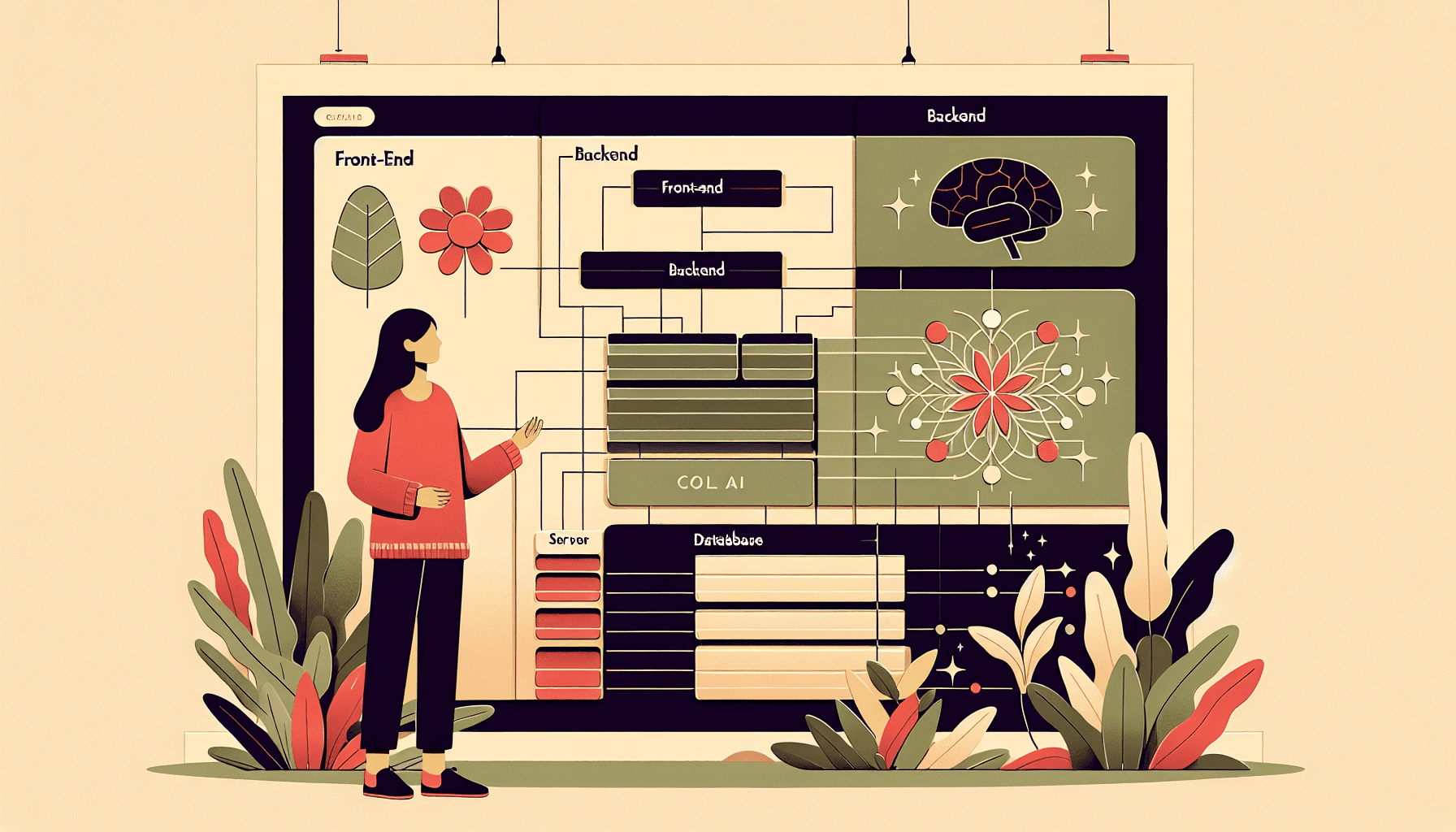
You have a SaaS idea. It probably involves AI (in 2026, it should). Now someone tells you that you need to pick a "tech stack" and suddenly you're drowning in acronyms: React, Next.js, Node, Python, LLMs, RAG, vector databases, embeddings, fine-tuning...
Here's the truth: you don't need to understand all of that to make a smart decision. But in 2026, choosing a tech stack isn't just about the web framework anymore — it's about choosing the right AI infrastructure too. Let me translate both into business decisions you already know how to make.
The 2026 Tech Stack Has a New Layer
Think of your tech stack like a building. In 2024, you had three floors:
- Frontend — What users see (React, Next.js)
- Backend — Business logic (Node.js, Python)
- Database — Where data lives (PostgreSQL, Firebase)
In 2026, there's a fourth floor that didn't exist two years ago:
- AI Layer — The intelligence (LLMs, vector databases, embeddings, AI orchestration)
This layer is where your SaaS gets its competitive edge. Choose wrong here, and you're either burning money on AI costs or stuck with a provider that limits your product.
The AI Layer: Decoded for Non-Technical Founders
Let me translate the AI jargon into concepts you can reason about:
LLM (Large Language Model) — The "Brain"
This is the AI that reads, writes, and reasons. You're choosing between providers:
| Provider | Best For | Cost | My Take |
|---|---|---|---|
| Claude (Anthropic) | Long documents, nuanced reasoning, coding | $$ | My default choice — best quality-to-cost ratio in 2026 |
| GPT-4o (OpenAI) | General purpose, image understanding | $$$ | Good but expensive at scale |
| Gemini (Google) | Multimodal, large context windows | $$ | Strong for specific use cases |
| Open Source (Llama, Mistral) | Privacy-sensitive, high-volume, low-cost | $ (hosting costs) | Only if you have ML expertise on the team |
Key decision: Don't lock into one provider. Your developer should build a provider-agnostic AI layer so you can switch as pricing and capabilities evolve (they change monthly).
Vector Database — The "Memory"
If your SaaS needs to search through documents, knowledge bases, or any large collection of text, you need a vector database. In plain English: it's how your AI "remembers" and finds relevant information.
- Pinecone: Managed, easy to start, good for most startups
- Weaviate: More features, self-hostable, good for privacy-conscious products
- pgvector (PostgreSQL extension): Keep everything in one database — great for under 500K documents
- ChromaDB: Lightweight, open-source, good for prototyping
My recommendation: Start with pgvector if your dataset is modest. Move to Pinecone or Weaviate when you outgrow it. Don't over-engineer this on day one.
RAG (Retrieval-Augmented Generation) — The "Research Assistant"
RAG is how your AI answers questions using YOUR customer's data instead of its general training data. Think of it as: the AI does research in your database before answering.
This is the core architecture behind:
- AI customer support bots that know YOUR product
- Document Q&A features ("ask questions about this PDF")
- AI assistants that reference company knowledge bases
- Smart search that understands intent, not just keywords
Why this matters to you: If your SaaS touches any kind of domain-specific knowledge, RAG is how you make AI useful for your customers instead of just generic. It's the difference between "a chatbot" and "an AI that actually knows our business."
The Complete 2026 Stack: My Recommendation
After building AI-powered SaaS products across multiple industries, here's the stack I recommend:
Web Layer
- Frontend: Next.js (React) with TypeScript — server-side rendering, massive ecosystem, AI-friendly streaming support for real-time AI responses
- Backend: Node.js with Next.js API routes — same language front-to-back, excellent for real-time AI streaming to the UI
- Database: PostgreSQL (with pgvector for AI embeddings) + Firebase for real-time features
- Auth: Clerk or Firebase Auth — don't build this yourself, especially not with AI-generated code
- Payments: Stripe — with usage-based billing support for AI features
- Hosting: Vercel (frontend) + Railway (backend/AI workers)
AI Layer
- Primary LLM: Claude API (Anthropic) — best reasoning quality for SaaS use cases
- Fallback LLM: GPT-4o — automatic failover when primary is down
- Embeddings: OpenAI text-embedding-3 or Cohere — for converting text to searchable vectors
- Vector Store: pgvector to start, Pinecone at scale
- AI Orchestration: LangChain or custom — for chaining multiple AI calls together
- Monitoring: LangSmith or Helicone — track AI costs, latency, and quality per customer
The Four Questions That Matter in 2026
Question 1: Can I hire for this later?
| Technology | Hiring Pool | Cost Range |
|---|---|---|
| React / Next.js | Massive | $80–$180/hr |
| Python (AI/ML) | Large | $100–$200/hr |
| Node.js + LLM Integration | Growing fast | $90–$180/hr |
| Full-Stack + AI Architecture | Small (rare skill) | $150–$250/hr |
Notice that last row. Developers who can build the web app AND architect the AI layer are rare. That's the person you want building your SaaS — not separate teams that don't talk to each other.
Question 2: Does my AI layer scale without bankrupting me?
AI costs scale with usage, not users. 100 users making 50 AI calls/day costs the same as 10 users making 500 calls/day. Your tech stack needs:
- Per-request cost tracking from day one
- Caching for repeated AI queries (save 30–60% on costs)
- Smaller/faster models for simple tasks, larger models only when needed
- Queue-based processing for non-real-time AI tasks
Question 3: How fast can we iterate on AI features?
AI features need to evolve faster than traditional features. Your stack should support:
- Prompt versioning — change AI behavior without code deploys
- A/B testing different models or prompts
- Feature flags for AI capabilities per tier
- Real-time monitoring of AI quality (accuracy, relevance, hallucination rates)
Question 4: Is the AI provider-agnostic?
The AI landscape changes monthly. Lock into one provider and you're stuck with their pricing, limitations, and outages. An abstraction layer that lets you swap Claude for GPT-4 for Gemini — without changing your product code — is non-negotiable.
Red Flags When a Developer Proposes a Stack
- "We'll add AI later" — In 2026, this is like saying "we'll add mobile support later" in 2015. AI should be in the architecture from day one, even if V1 features are simple.
- "We should fine-tune our own model" — Unless you have 100K+ training examples and ML expertise, this is premature. RAG + good prompts gets you 90% there at 1% of the cost.
- "Let's use LangChain for everything" — LangChain is great for prototyping but adds significant complexity. For production SaaS, a thin custom AI service layer is often better.
- "We need GPT-4 for everything" — Different tasks need different models. A classification task that Claude Haiku handles at $0.001 doesn't need GPT-4 at $0.03. Using the right model per task saves 80% on AI costs.
- "Don't worry about AI costs, they'll go down" — They might. But "hope" isn't a cost management strategy. Build usage tracking from day one.
What to Do Next
- Define your product requirements — especially which features involve AI (my 30-day MVP roadmap walks you through this step by step)
- Find a developer who's built AI-integrated SaaS before (not just web apps, not just ML models — the intersection)
- Ask them to explain their AI strategy: which models, how they manage costs, how they handle provider outages
- Evaluate based on the four questions above
The best tech stack in 2026 is the one that gets your AI-powered product to paying customers fastest — and at the right cost — while keeping your AI costs predictable and your architecture flexible.
Got a tech stack proposal you're unsure about? Book a free 30-minute call and bring it — I'll tell you straight whether it makes sense for your AI-powered product.