By Nikhil Garg — ex-CTO, 13+ years building and shipping software
Let me say this up front, because the internet has turned it into a war: I am not anti–vibe coding. I use these tools. They're genuinely remarkable. If you're a non-technical founder, vibe coding might be the best thing that's happened to you in a decade.
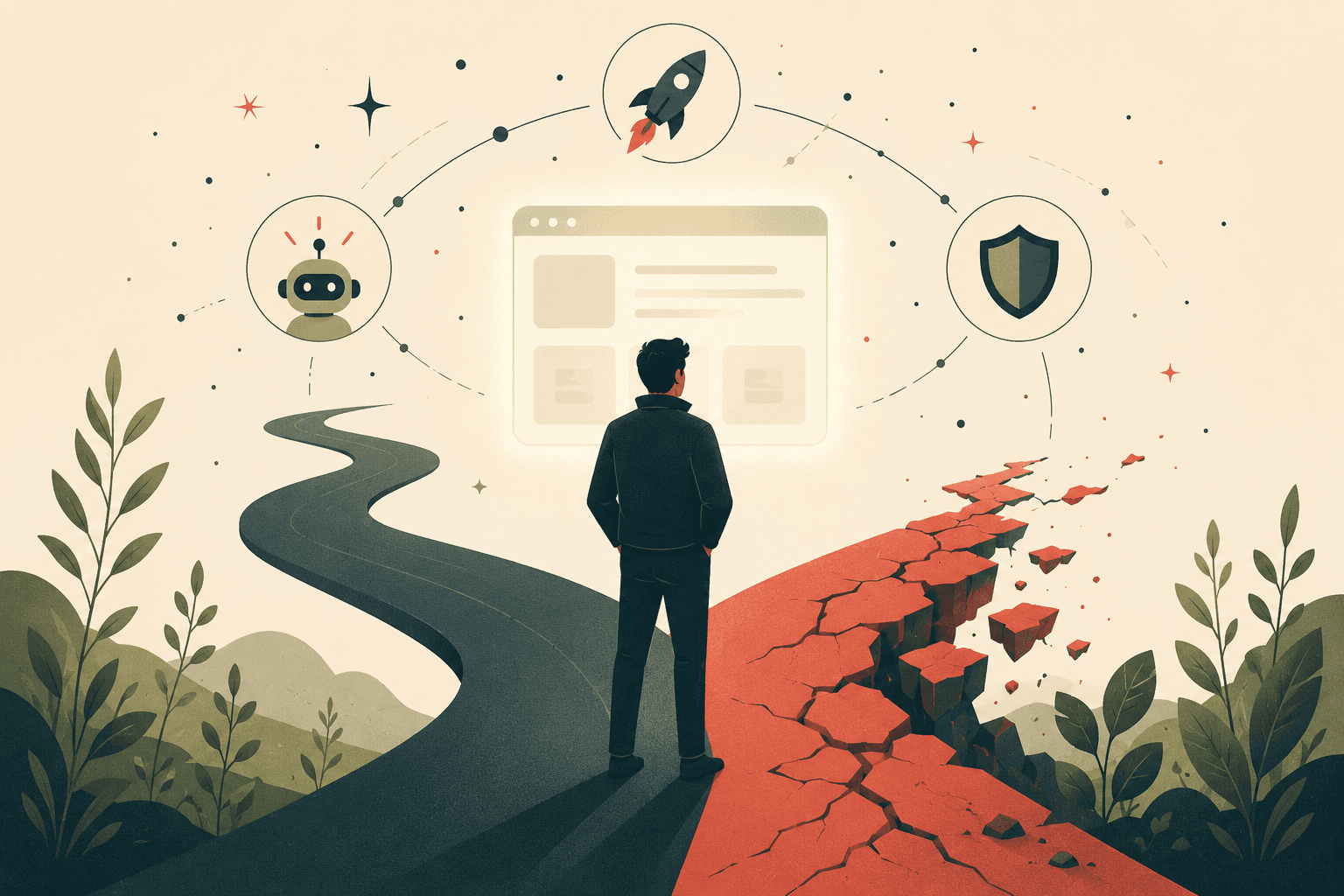
It can also quietly wreck your company if you misunderstand what it's for. This is the honest guide — not a take-down, not a sales pitch — to help you figure out when to vibe code and when to hire a real developer.
What vibe coding is, and why it went viral
"Vibe coding" is the now-popular term for building software by describing what you want in plain English to an AI tool — Cursor, Lovable, v0, Bolt, Replit Agent, Claude Code — and letting it write the actual code. You don't touch syntax. You say "build me a dashboard where users can upload a CSV and see a chart," and a working-ish app appears.
It went viral for an obvious reason: it collapsed a barrier that stood for fifty years. For decades, having a software idea and building it were separated by years of learning to code or tens of thousands of dollars hiring someone. Vibe coding made that gap feel like it vanished overnight. A founder with no technical background can now sit down on a Saturday and have something on screen by Sunday.
The hype is earned, to a point. What used to take a developer a week can take an afternoon. The demos are real. The "I built this without writing a line of code" tweets are real. But "I built something" and "I built a product I can sell and scale" are very different claims — and the gap between them is exactly what this post is about.
What vibe coding is genuinely great for
Let me be specific and generous here, because the strengths are real and you should use them.
Validating an idea visually. The single hardest thing about an early idea is that it lives in your head. Vibe coding gets it onto a screen fast, so you can look at it, click it, and feel whether it's right. That's worth enormous amounts. You'll learn more from one clickable screen than from ten pages of specs.
Investor and stakeholder demos. When you need to walk into a room and show — not tell — what you're building, a vibe-coded prototype is perfect. Investors want to see the vision made tangible. A polished prototype that demonstrates the core flow can absolutely help you raise, and nobody in that room is auditing your database schema.
UI and UX prototyping. Want to test three different layouts for your onboarding flow? Vibe coding lets you generate all three in an hour and put them in front of real users. This is iteration speed that simply didn't exist before, and it's a genuine superpower for figuring out what your product should feel like.
Internal tools and low-stakes apps. A dashboard ten people on your team use, an internal admin panel, a quick utility — if the blast radius of a bug is small and the users are forgiving, vibe coding is often all you need. Don't over-engineer what doesn't need it.
The common thread: vibe coding shines when the goal is learning, showing, or low-stakes doing. It's a phenomenal tool for reducing uncertainty quickly. The trouble starts when founders mistake the prototype for the product and try to put it in front of paying customers. That's the same trap I unpack in how to build a SaaS without getting burned by AI tools or agencies.
Where vibe coding fails — and why it's not the AI's fault
Here's the part nobody selling you a tool will explain. These failures aren't because the AI is dumb. They're because production software has requirements that don't show up in a demo, and the AI optimizes for making the demo work, not for the invisible things that matter at scale.
Multi-tenant architecture. The moment you have real customers, you need each one's data isolated — Company A must never, ever see Company B's records. Getting this right means careful data modeling, row-level security, and access controls woven through the entire app. Vibe-coded apps routinely get this subtly wrong in ways that work fine in testing and become a catastrophic data leak the day two real customers log in. You won't see it coming, because the demo worked.
Payment edge cases. A Stripe button is easy. What's hard is the long tail: failed renewals, prorations when someone upgrades mid-cycle, refunds, disputed charges, webhooks that fire twice, a subscription that says "active" in Stripe but "cancelled" in your database. This is money, and the edge cases are where amateur billing silently loses it. AI will happily generate the happy path and leave the dangerous 20% unhandled.
Compliance and security. If you touch health data, financial data, or EU users, you have legal obligations — HIPAA, SOC 2, GDPR — that are not features you can prompt your way into. They require deliberate architecture, audit trails, and decisions a tool doesn't know to make unless an experienced human tells it to. A security vulnerability baked into generated code is invisible until someone exploits it.
Real-time at scale. A live chat or collaborative feature that works for you and three test users behaves completely differently at a thousand concurrent connections. Websockets, race conditions, state synchronization, and infrastructure that holds up under load are a different discipline entirely — one of the technical decisions that will haunt your startup if you get it wrong early.
The invisible architecture decisions. This is the big one. A senior developer makes hundreds of small choices — how to structure the database so it doesn't need a painful rewrite, where to add an index, how to handle errors gracefully, what to log so you can debug a 2am outage. The AI doesn't make these unless asked, and you don't know to ask. That's precisely the AI architecture mistake I broke down in 6 SaaS architecture mistakes that cost $50k to fix. The code compiles. It even runs. It's just built on a foundation that cracks the moment real weight lands on it.
The one question that settles it: demo or product?
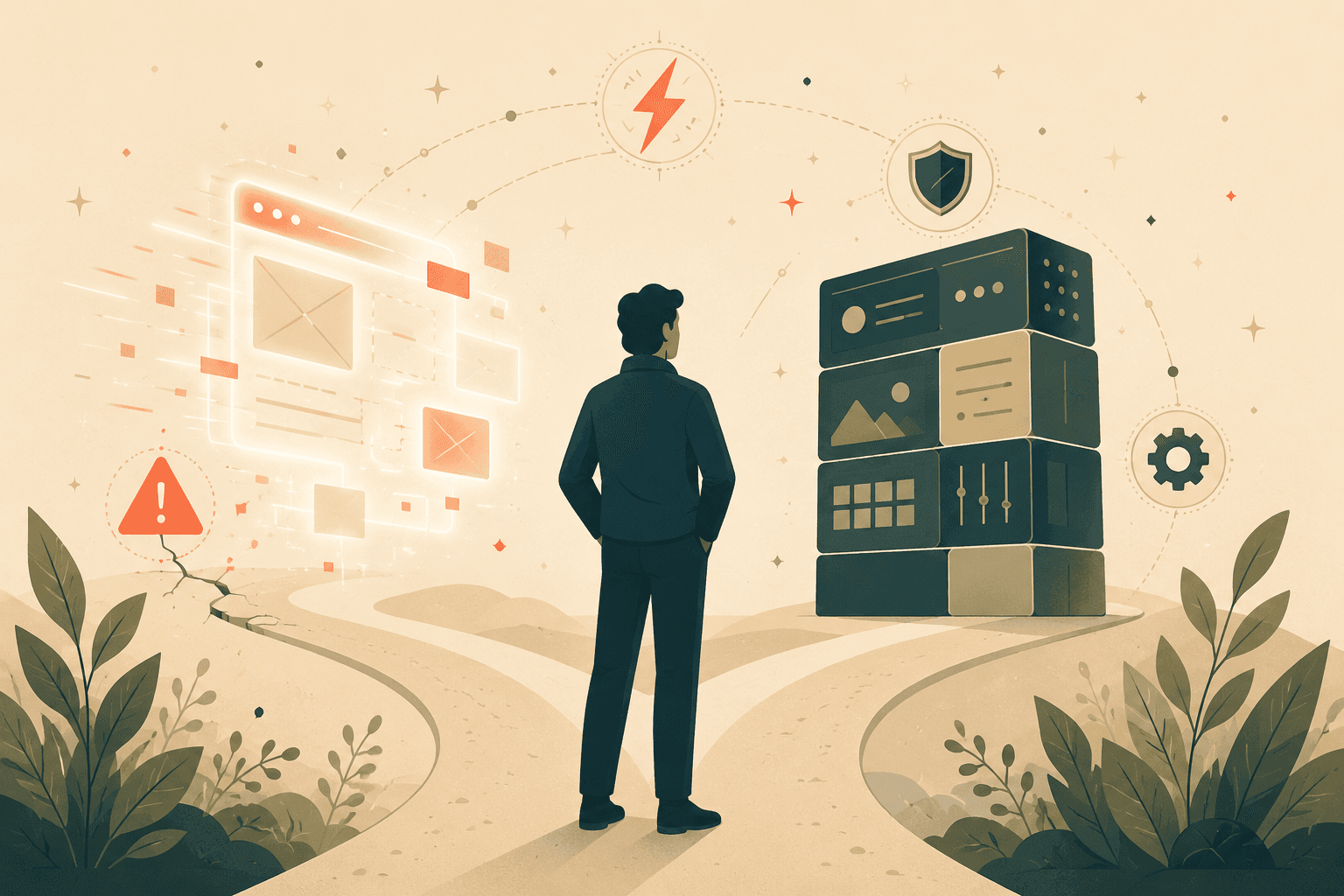
Strip away all the noise and it comes down to a single question: Am I building a demo, or a product?
A demo exists to communicate an idea — to yourself, to users, to investors. Its job is to be seen and clicked. If it breaks, nobody loses money or data. For a demo, vibe code with abandon. It's the best tool for the job.
A product exists to be relied on by people who pay you. It handles their money, their data, their trust. If it breaks, you lose customers, cash, or worse. A product needs the invisible 80% that demos skip — and that's where you need someone who's built one before.
Be honest about which you're making right now. Most founders need a demo first and a product second. The mistake isn't using vibe coding. The mistake is shipping the demo to paying customers and calling it a product.
The hybrid approach (what I actually recommend)
Here's the part that resolves the false war: it's not vibe coding versus hiring a developer. The smart play uses both, in sequence.
Phase one — prototype with AI. Use vibe coding to validate your idea, nail the UX, build the investor demo, and get real user feedback. Move fast, spend almost nothing, and learn what your product should actually be. Don't hire anyone yet. You'd be paying a developer to build something you're still figuring out.
Phase two — productionize with a developer. Once you've validated and you're ready for paying customers, bring in an experienced developer to build the real thing — properly architected, secure, multi-tenant, payment-hardened. Sometimes they rebuild on the prototype's lessons; sometimes they harden what's there. Either way, your AI prototype wasn't wasted — it became the clearest spec you could possibly hand them.
This is the most efficient path I know: AI for speed and learning, a human for durability and trust. It's exactly how I work with founders in hiring your first developer, and it's the model behind my own SaaS MVP development work. If you've already vibe-coded something into a corner, that's what an AI codebase rescue is for.
Not sure which phase you're in? Let's figure it out.
If you're staring at a vibe-coded prototype wondering whether it's ready for real customers — or whether you should rebuild — that's a five-minute conversation, not a leap of faith.
I help non-technical founders make exactly this call: what your AI prototype got right, what'll break under real users, and whether to harden it or rebuild. No pitch to scrap your tools — I like them too. Just a straight answer from someone who's shipped the production version many times over.
Let's talk — bring me your prototype, your idea, or just the question keeping you up at night. I'll tell you honestly whether you've got a demo or a product, and what it takes to bridge the gap.