
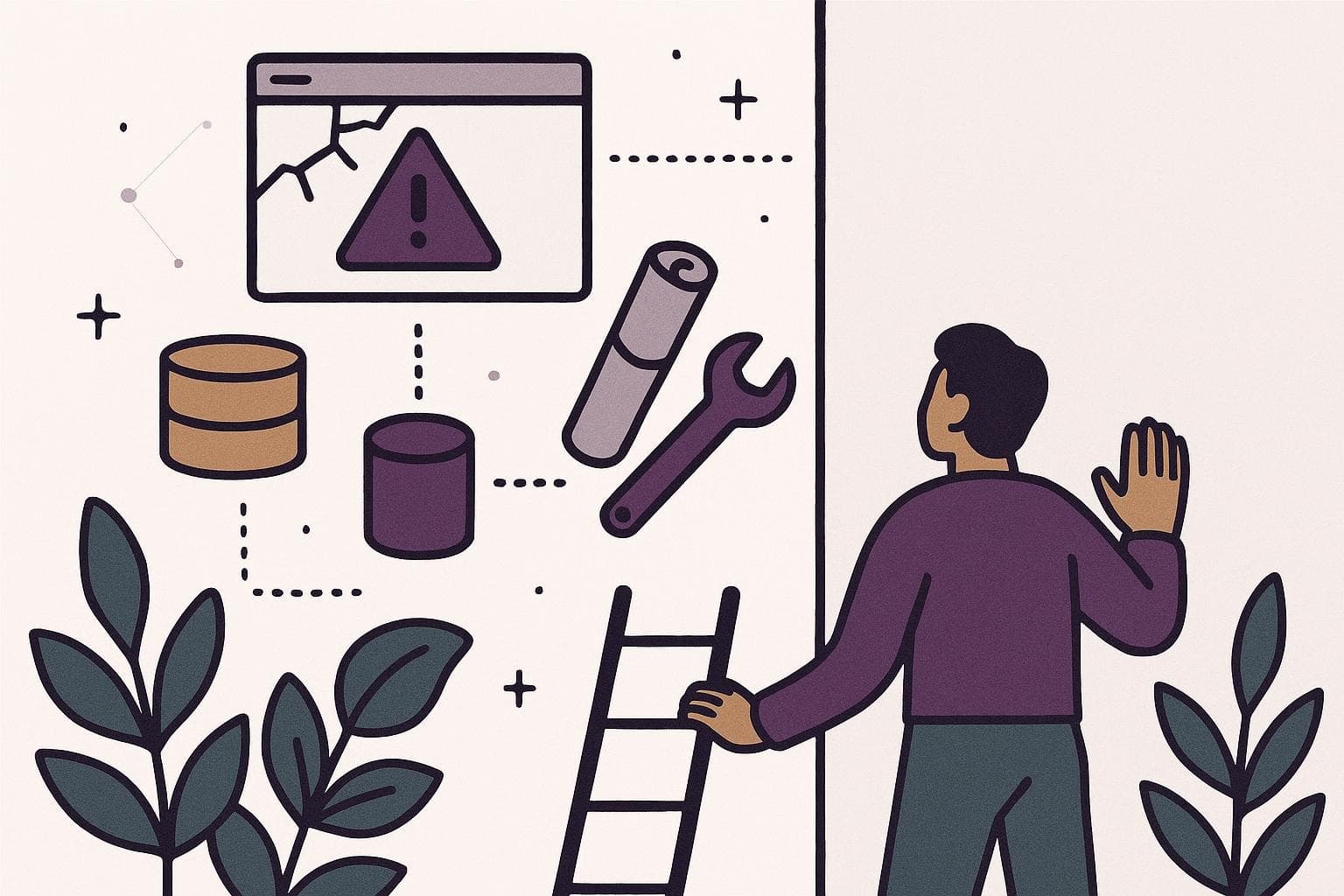
You built something real in Bolt. It worked. Then you tried to add one more feature, and the whole thing started breaking in ways it never did before. You fix one thing, two others break. Now you are staring at the screen wondering if you outgrew Lovable and what next, or if you just hit a bug you can talk your way past. I get this exact message almost every week. Let me give you the real answer, because it is not the same for everyone.
The wall every no-code AI builder eventually hits
Here is what nobody tells you when you start. Tools like Bolt and Lovable are genuinely amazing for the first 60 to 70 percent of an app. You describe what you want, it writes the code, you see it working. That feels like magic because it kind of is.
The wall shows up later. It always shows up. Your app has grown to a few dozen features. There is real data in it now, real users, real edge cases. The AI is no longer holding a small, clean picture in its head. It is trying to change one part without understanding how it connects to five other parts. So it breaks them.
This is not you doing something wrong. It is the nature of the tool. AI code generators are great at greenfield and bad at surgery. The bigger and more interconnected your app gets, the more every new request becomes surgery. I wrote about why my own AI-built MVP failed in production for exactly these reasons. The wall is a stage, not a verdict. Almost every serious project hits it. The question is what you do when you get there.
How to tell if you outgrew the tool or just hit a bug
Before you panic and hire someone, figure out which problem you actually have. They look similar from your chair but they are completely different.
It is probably just a bug if:
- One specific feature broke, and the rest of the app still works fine.
- The AI made a change and you can describe exactly what stopped working.
- Rolling back to a previous version fixes it.
- The problem is visual or a single broken button, not the whole flow.
Bugs are normal. Even hand-written code has them. If you can undo the last change and get back to working, you have not hit the ceiling. You hit a pothole.
You have genuinely outgrown the tool if:
- You ask for a feature and the AI keeps breaking unrelated parts every single time.
- The same bug comes back after you fix it, over and over.
- You cannot add anything involving payments, permissions, or complex data without chaos.
- The app is slow and no prompt fixes it.
- You are scared to touch it because you do not know what will break.
That last one is the real tell. When you stop shipping because you are afraid of your own app, the tool is no longer serving you. The friction has flipped. It used to make you faster. Now it makes you slower. That is the signal that you need a developer to look under the hood, not a better prompt. If you want a broader frame on this, I laid out the trade-offs in vibe coding versus hiring a real developer.
Three paths: keep patching, migrate the code, or rebuild
Once you know you have hit the ceiling, you have three real options. Most people assume it is start over or nothing. It is not.
1. Keep patching in the tool
Valid if your app is simple and close to done. If you only have a handful of features left and none of them touch money or user permissions, keep going. Do not hire anyone yet. Patching is cheapest and you already know how to do it. The catch: this only works if the breaking is occasional, not constant. If every change starts a fire, patching just delays the real decision and burns your energy.
2. Migrate the code to a developer
This is the option most founders do not know exists. Bolt and Lovable write real code. React, a database, actual files. A developer can export that code, take it out of the tool, and keep building on it in a normal professional setup. You keep your work. You keep your data. You just move it somewhere it can grow.
This is the right call maybe 60 percent of the time in my experience. The AI got you a real foundation. It just cannot maintain it anymore. A developer can. This is exactly what AI codebase rescue is: taking what you built and making it safe to keep building on.
3. Rebuild from scratch
Sometimes the honest answer. If the generated code is a tangled mess, if the data structure is fundamentally wrong, or if the app does something the original design cannot support, rebuilding is faster than untangling. It feels like a step back. It usually is not, because now you know exactly what you want, and a clean build with a spec that survives is often quicker than an 8-week MVP would be. The decision between migrating and rebuilding is the whole game, and it depends entirely on the state of your code. You cannot judge it from the outside. That is why the first thing a good developer does is read it.
What actually transfers when a developer takes over your Bolt project
Here is the good news, and it is genuinely good. More transfers than you think.
- Your data. Users, records, everything you have collected. This almost always moves cleanly. You do not lose your customers.
- The design and layout. The look of your app, the screens, the flow. This transfers well because it is the part AI does best.
- The product decisions. Every feature you built taught you something. That knowledge is yours and it does not live in the code. It lives in your head.
- A lot of the code itself. Not all of it. But the parts that work become a reference, even if some get rewritten.
What does not transfer cleanly is the messy plumbing. The way the AI wired things together behind the scenes is often the part that gets redone. That is fine. That plumbing is exactly what was breaking. Think of it like renovating a house. You keep the layout and the good rooms. You rip out the wiring that keeps tripping the breaker.
The mistake I see is founders assuming a takeover means losing everything. It rarely does. Even in a full rebuild, you are rebuilding from a working reference, not a blank page. That is worlds easier and cheaper. If cost is on your mind, run your numbers through the SaaS MVP cost calculator so you have a real range instead of a guess.
How to hand off without losing your work or your momentum
You have a window here. Do not stall out. Here is how to hand off cleanly.
- Stop making risky changes. The moment you decide to bring in help, freeze the app. Do not let the AI make one more big change that a developer then has to untangle.
- Write down what breaks. A plain list of what works, what breaks, and what you were trying to add when it fell apart. This is the most useful thing you can hand over. A good developer reads it before touching a line.
- Give access, not screenshots. The developer needs the actual project and the code export. Screenshots waste everyone's time.
- Ask for a read before a quote. Anyone who quotes you a price without reading your code is guessing. The honest first step is a review of what you have, then a recommendation on which of the three paths fits.
One more thing. If your last developer disappeared and left you with this, that is a different but related mess. I wrote a whole piece on what to do when your developer ghosts you. And once you are back to shipping, watch what tends to break in the first 90 days so you do not get surprised again.
Hitting the ceiling on Bolt is not a failure. It means you built something real enough to outgrow the training wheels. If you want someone to read your code and tell you honestly whether to patch, migrate, or rebuild, that is exactly what my AI codebase rescue work is for. Send me what you have. I will tell you the truth about it before you spend a dollar building anything.